Child smiling and doing a fingerplay.

Preschool Counting Songs and Fingerplays

Counting songs and fingerplays help children develop early language, listening, math, and fine motor skills. Early familiarity with rhymes and word patterns is also associated with reading and spelling skills. Explore the videos and use the teaching tips on this page to help children learn the words and motions. Most importantly, have fun together!
Preschool Counting Songs and Fingerplay List

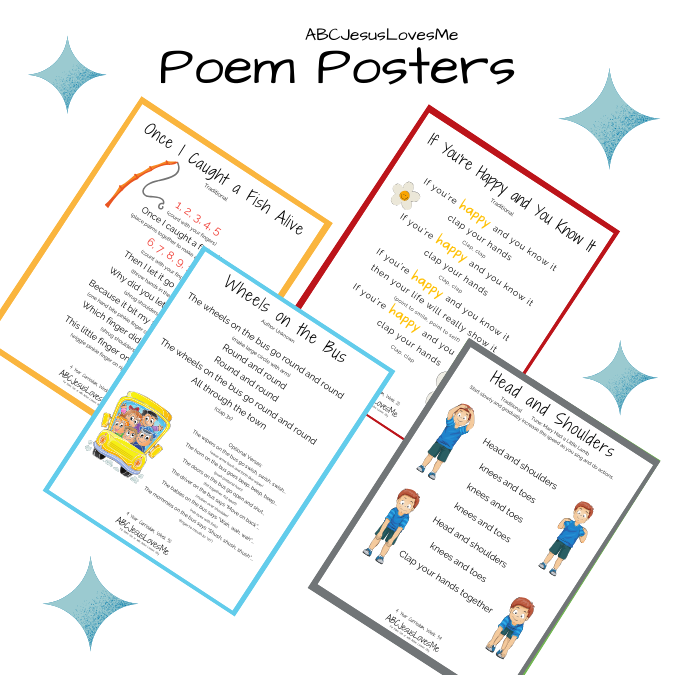
Poem Posters


Jumpstart Pre-Reading Fun with Engaging Poems! 📚

Give your preschooler a head start on pre-reading skills with age-appropriate poems that your child or students will enjoy.  Colorfully created packet contain recognizable images and fun actions for the pre-reading activities. 

     Poem Packets     

Tips for Teaching Counting Songs and Fingerplays

    • Slow, Slow, Slow
      Young children need time to hear the words, process the meaning, and coordinate their fingers and arms. Gradually increase the speed as they become familiar with the song or poem. When the pace is too fast, children often stop participating.

    • Pause
      Stop just before a familiar or rhyming word or movement and let the child fill in the missing part. This encourages listening, memory, phonological awareness, and participation.

    • Make Your Hands Easy to See
      Hold your hands at chest level where children can clearly see your fingers. Avoid moving your hands too quickly or holding them too close to your body.

    • Make Small Movements Bigger When Needed
      Exaggerate all movements. Open your hand wide, spread your fingers, or move them slowly.

    • Mirror All Actions
      Children will mirror your movements. To help them lift their right hand, lift your left hand. When possible, move from left to right to help children become familiar with the direction of reading.

    • Change Your Volume
      Try whispering, speaking louder, or using a quiet voice when appropriate to help children notice words and sounds. 
    • Show Each Number
      Hold up fingers, number cards, or objects as the numbers are recited or sung.

    • Count One Thing at a Time
      Touch or move one object for each number spoken to help children connect counting words with quantities. If a child says numbers quickly without matching them to objects, slow down and have the child touch each item as you count.

    • Slow Down at the End
      Give children extra time to say the last few numbers, especially when counting backward.

    • Change the Starting Number
      Once children know a counting song, begin at a different number to help them learn that counting can start anywhere.

    • Take Away as You Count
      For songs like “Five Little Ducks,” remove one toy or picture each time a character leaves. Let children see the quantity change.

    • Mix Up the Objects
      Count different items, such as blocks, toy animals, or buttons, to help children understand that counting works with many kinds of objects.

    • Learn Cardinality
      Cardinality is understanding that the last number said when counting a group tells how many items are in the group altogether. After counting a group of objects, ask, “How many are there?” 

    • Make Mistakes on Purpose
      Skip a number or count out of order in a familiar song. Invite children to catch the mistake.

    • Explore More and Less
      After a counting song, ask, “What happens if we add one more?” or “How many are left if we take one away?”

Discover More Ideas

 
This page may contain affiliate links. Please read our disclosure policy.