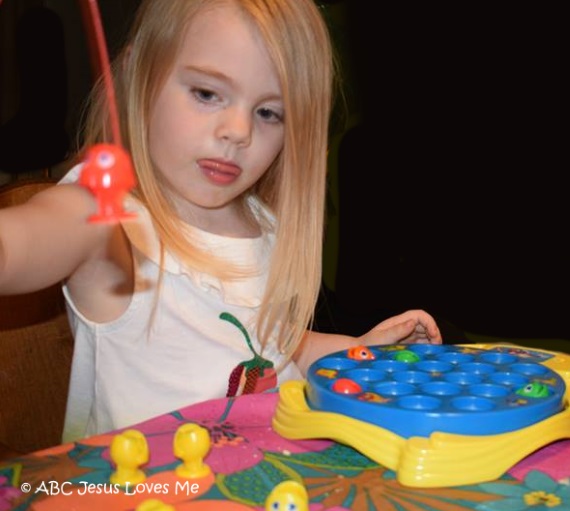
One of my children's favorite learning activities was going "fishing" right in our living room! Every fish they caught became an opportunity to practice an academic or Bible concept, yet they were having so much fun they didn't even realize they were learning.
A fishing game is inexpensive to make, simple to customize, and can be used over and over as your child grows. It works with almost every objective in the ABCJesusLovesMe Curriculum, including letters, letter sounds, numbers, shapes, colors, memory verses, comprehension questions, gross motor activities, and much more. It also develops fine motor skills, hand-eye coordination, visual tracking, turn-taking, listening skills, and attention span. Just use your imagination!
Fishing Pole Supplies:
Tie the string securely to one end of the dowel rod, then attach a magnet to the other end of the string. Make sure all knots are tight so the magnet stays securely attached during play.
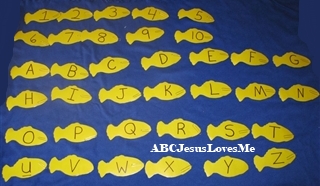
Fish Supplies:
Cut fish shapes from colorful cardstock using a fish template. If you have access to a die-cut machine, it can save time. Write the learning concept you want to practice on each fish, such as:
For durability, laminate the fish or cover them with clear contact paper. Attach a large paper clip where the fish's mouth would be so the magnet can easily "catch" it.
Simple Option: Instead of cutting fish shapes, write the learning concepts on 3 × 5-inch index cards and attach a large paper clip to each card.
If you would rather not make your own game, you can purchase a child-sized magnetic fishing pole. Magnetic letters and numbers also work well as fish when turned upside down.
Purchase the Let's Go Fishing game. Write with a dry erase marker on the bottom of the fish various academic learning. As the child catches a fish, turn it over and name the objective.
For example: Draw different numbers on the bottom of each fish. Have the child catch a fish, name the number, and clap that many times.
Scatter the fish on the floor, in a laundry basket, inside a large bowl, or on a blue blanket to represent water.
As your child catches each fish, ask them to identify what is on it. Depending on the activity, they might:
Keep the activity short and successful. Instead of placing every fish out at once, begin with only a few. This keeps children engaged and prevents frustration. Include a mixture of concepts they already know along with a few that provide a gentle challenge.
Always supervise children during this activity. Magnets can be a choking hazard if swallowed, and a magnet swinging on a string can cause eye injuries. Store the fishing pole out of reach when it is not being used.
Letter Fishing: Write one letter of the alphabet on each fish. When your child catches a fish, have them:
As your child becomes more confident, add lowercase and uppercase letter matching or ask them to catch a specific letter.
Number Fishing: Catch numbers in order, identify the number, count objects, or solve simple addition and subtraction problems.
Color Fishing: Catch a color, then find something in the room that matches.
Shape Fishing: Name the shape and find another object with the same shape.
Bible Fishing: Catch a Bible character, story object, or memory verse reference.
Beginning Sound Fishing: Catch a picture and identify its beginning sound.
Rhyming Fishing: Catch two fish that rhyme.
Sight Word Fishing: Read the word before keeping the fish.
Movement Fishing: Write actions such as "hop 5 times," "spin," or "touch your toes."
Matching Fishing: Catch one fish, then find its matching uppercase/lowercase letter, number quantity, shape, or picture.
Team Play: Take turns fishing and encourage children to help one another if someone gets stuck.
Seasonal Fishing: Create fish shaped like apples, pumpkins, hearts, snowflakes, or Easter eggs to coordinate with holidays and seasons.
The possibilities are endless! Change the fish to match the lesson you are teaching, and your child will look forward to learning every time they go "fishing."