Creating a purposeful learning environment sets the tone for both growth and fun throughout the school year. This page outlines practical tips for designing a classroom for toddlers and preschools and explains why each element matters in supporting development, safety, and play-based learning.
You'll discover on this page:
National Association for the Education of Young Children (NAEYC) gives the top rating to a toddler that is "designed to nurture children's curiosity, independence, and growth, providing a vibrant and safe space for toddlers to explore. The room features an open layout with distinct areas for various activities, including interactive centers with building blocks, sensory tables, art stations, and a cozy reading nook. Bright and cheerful décor with colorful murals and educational posters creates an engaging environment, and daily routines balance active play with quiet time in designated areas. Experienced staff offer nurturing care, support social skills, and communicate openly with parents about each child's development. Meals and snacks are managed to promote health and independence, enhancing the overall supportive atmosphere that fosters exploration and learning." Source
A high-quality preschool classroom is a warm, welcoming environment where caring teachers build strong relationships with children and families while providing meaningful opportunities for learning through play. The classroom is also a safe space emotionally and physically for children with disabilities or English Language Learnings. Children spend their days exploring engaging learning centers, participating in a balance of teacher-guided and child-led activities, and developing academic, social, emotional, and problem-solving skills through hands-on experiences. Teachers thoughtfully observe each child's growth to guide future learning, ensuring activities are developmentally appropriate and inclusive of every child's abilities, culture, and background. Strong communication with families and a joyful, purposeful atmosphere help create a classroom where children feel safe, valued, and excited to learn. Adapted from the National Association for the Education of Young Children (NAEYC): "What Does a High-Quality Preschool Program Look Like?"
When creating a preschool classroom, the concept “less is more” applies. In Life-Span: Human Development, authors Carol K. Sigelman and Elizabeth A. Rider explain that performance improves when distractions in materials and the environment are kept to a minimum. Fewer visual and environmental distractions help children focus and complete tasks more successfully.



Is ABCJesusLovesMe the right fit for your preschool, daycare, or church? All your questions can be answered during a private remote meeting.
Please note that remote sessions are exclusively for institutions and are not available to individual families.

1. Provide a well-lit, appropriately sized learning space. Tables and chairs should fit the child so that feet rest flat on the floor and hips and knees form 90-degree angles. This posture provides stability and comfort for writing.
2. Children develop fine motor skills best when working on a vertical surface. Holding a writing utensil or brush against a vertical surface strengthens the muscles in the wrist and hand—muscles not used in the same way on a horizontal surface. For this reason, place craft, writing, and drawing activities on a vertical surface whenever possible (e.g., an easel, wall, or door).
While classrooms are inviting and inspiring, there’s no need to recreate a full classroom in your home. Instead, weave learning naturally into daily life rather than limiting it to one specific spot or time.
Provide a child-size table and chair, open floor space, and a thoughtful selection of quality toys. Keeping the number of toys manageable—or rotating them so only a few are available at once—helps the child stay engaged. I found it helpful to store similar toys in labeled boxes in a closet. When my kids wanted something specific, I simply pulled out that box. After they finished playing, we cleaned it up and traded it for another. Books stayed in an easy-to-reach basket so reading was always within reach.
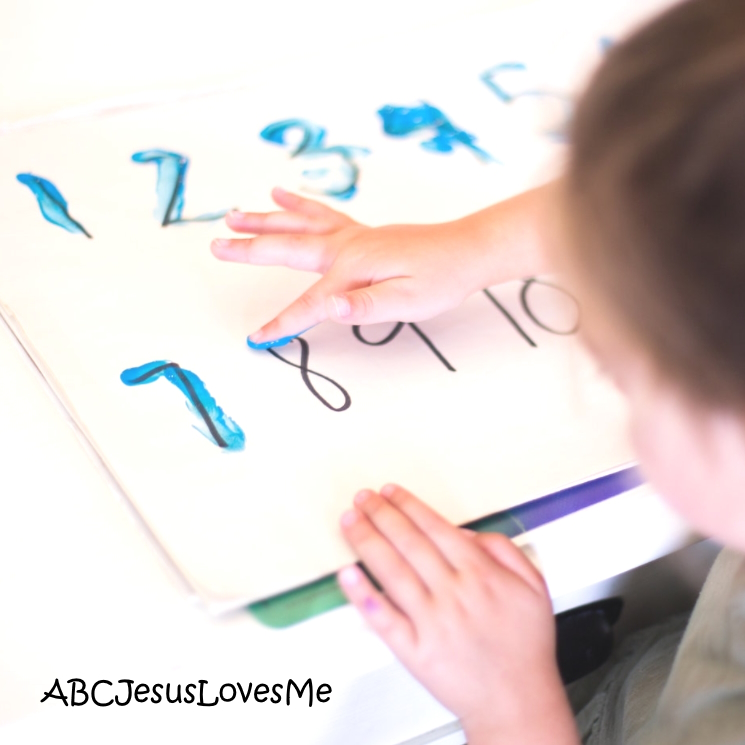
Watch a child confidently learn through engaging, hands-on activities in the ABCJesusLovesMe Preschool Curriculum. With a focus on both academics and biblical values, this program nurtures development in every area, all while making learning fun. Click to discover how we can support a child's educational journey!

Research consistently shows that media—whether educational or not—activates a different part of the brain than hands-on play. When a screen is on, the child isn’t building imagination, practicing fine or gross motor skills, or learning through social interaction and trial and error. For this reason, electronic use in a preschool classroom is best kept to a minimum.
Read More About Technology Use

To stay fully engaged with the child, teachers benefit from keeping media and cell phones out of sight during learning time. This helps ensure consistent monitoring, encouragement, and connection, with phones available only for true emergencies.

The colored dots on the floor guide the child to specific spots for lining up and participating in circle time. These markers give structure and help the child know exactly where to stand or sit.

Cubies offer the child a clear place to store personal items and learn responsibility for their belongings. Adding names to each cubie also supports name-recognition skills.


A rug and shelving help define learning centers, making each area feel intentional and inviting. This simple structure encourages the child to understand how each space is used.


A chair for the teacher ensures every child has a clear view during group time. Keeping a small basket of frequently used teaching props nearby makes transitions smoother and lessons more engaging.
A monthly calendar in circle time allows children to practice counting from 1-31.

A simple book nook gives the child the opportunity to choose a book and enjoy it in a child-sized chair. Rotating the book selection throughout the year keeps this area new and encourages daily reading.

Using the same area, a quick change of decor can change it from summer to fall.

Higher cabinets and cubies keep items that are unsafe or not child friendly out of reach.

Label shelves with pictures and words. This builds responsibility for putting items away and early literacy.
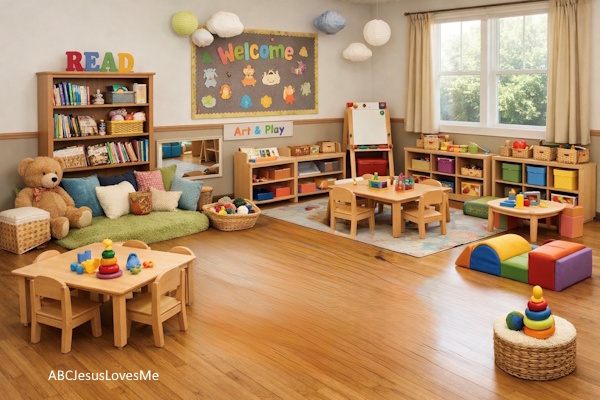
In a toddler classroom, open floor space allows the child to move, explore, and play freely. A low mirror placed on the wall at the child’s level supports self-awareness, social-emotional development, and language growth as the child observes facial expressions, body movements, and actions during play.
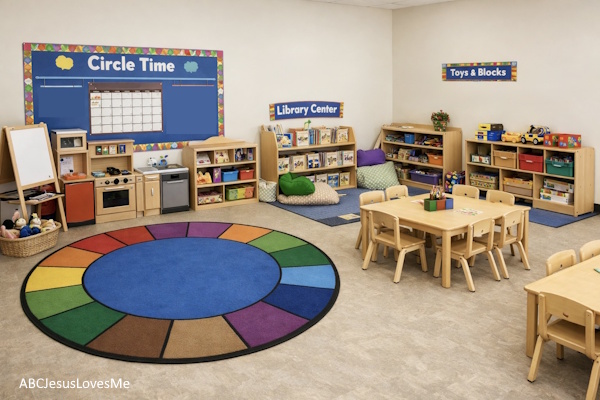
Provide low, sturdy shelves with only a few toys available at a time. This helps a child focus on meaningful play and reduces overwhelm.