The candy cane is a delightful way to introduce preschoolers to the true meaning of Christmas: the birth of Jesus! With its simple rhymes and vivid imagery, the poem and activities capture the essence of the season while offering engaging activities to reinforce the message. Explore this page for creative ideas, story books, and fun ways to incorporate the candy cane into your Christmas celebrations.
Adapted from Unknown Authors
Once there was a man who loved Jesus and wanted to do something special to celebrate His birth. He was a candy maker who wanted to create a candy that would remind people of the true meaning of Christmas, Jesus' teachings, and Easter. So, he made the Christmas candy cane.
He began with a stick of pure white, hard candy. The white color represented Jesus' virgin birth and sinless nature. The hard candy represented the Solid Rock, the foundation of the Church, and the firmness of God's promises.
The candy maker shaped the candy into a “J” for Jesus' name. When held straight up, the candy cane also looks like a shepherd's staff. This reminds us that Jesus is the Good Shepherd who cares for His sheep (John 10:14).
Then the candy maker added red stripes. These represented the stripes Jesus received when He was beaten before His crucifixion. Isaiah 53:5 and 1 Peter 2:24 remind us that “by his stripes we are healed.”
The red stripes also represented the blood Jesus shed on the cross so that we can have eternal life (Colossians 1:14). Through Jesus, our sins can be forgiven, and we can be made clean (Psalm 51:7).
In this story, the wide red stripe represents the one true God, and the three narrow stripes represent the Trinity: God the Father, God the Son, and God the Holy Spirit.
Today, the candy cane is a familiar Christmas decoration, but many people may not know the meaning behind these symbols. Although this story is often shared as the origin of the candy cane, its historical accuracy has not been verified. Still, the symbols can help us remember Jesus' birth, His sacrifice, and His gift of salvation.
Look at the Candy Cane, what do you see?
Stripes that are red like the blood shed for me
White is for my Savior Who's sinless and pure!
"J" is for Jesus My Lord, that's for sure!
Turn it around and a staff you will see
Jesus my shepherd was born for Me!
To introduce the poem and following activities, read one of the following books.

The Legend of the Candy Cane by Lori Walburg tells the story of how the candy cane symbolizes the birth of Jesus.

The Candymaker's Gift by David and Helen Haidle shares the story of a grandpa, humble candymaker, desires to create the perfect Christmas gift for his grandchildren to help them understand the true meaning of Christmas. Through this tale, children learn how the candy’s shape, colors, and stripes represent aspects of Jesus' birth and teachings.
Printables are free for family use or with an active ABCJesusLovesMe License.

Print and cut apart the poems and attach to a candy cane, craft, or activity to share the truth of Christmas.
Candy Cane Poem Option #1
Candy Cane Poem Option #2

Print the Candy Cane Poem worksheet for the child to decorate. Fingerpaint every other stripe on the candy cane red and talk about the AB pattern.

Celebrate Jesus' birthday with fun activities, meaningful conversation, and yummy cake to help children ages 3-12 understand the significance of Jesus' birth.
Using a salt dough recipe, make J's or candy canes with a cookie cutter or roll small amounts of dough into candy-cane shapes. Use a straw to make a hole for tying a ribbon. Paint red lines on the candy cane. Air dry for 24 hours turning one or twice to reduce curling. Tie a bell and the Candy Cane poem to the candy cane with ribbon. Give as gifts.
Twist a red and white pipe cleaner. Then bend the top to form a candy-cane shape. Can be used as a tree ornament.

Thread red and white beads or tri-beads in an AB pattern onto a pipe cleaner. Bend the ends to hold the beads on the pipe cleaner. Then curve the top to form a candy-cane shape. Hang by the hook of the candy cane on a Christmas tree.
Warning: Children under the age of three should not participate in activities in which small pieces are involved.

Just like an Easter Egg hunt, hide candy canes outside or in a large area for a child to find. Play Christmas music in the background encouraging the children to find all of them before the music stops.

Help your little ones learn their colors with these vibrant, fun flashcards—perfect for preschoolers! Click the link below to download your free set today and start learning through play.
Set up a relay race where preschoolers carry a ball in the crook of the candy cane from one side of the room to the other. The challenge is to keep the ball balanced on the candy cane!

Make or purchase red and white play dough. Show the child how to roll the dough into long snakes. Then, twist the red and white playdough together to form candy canes.
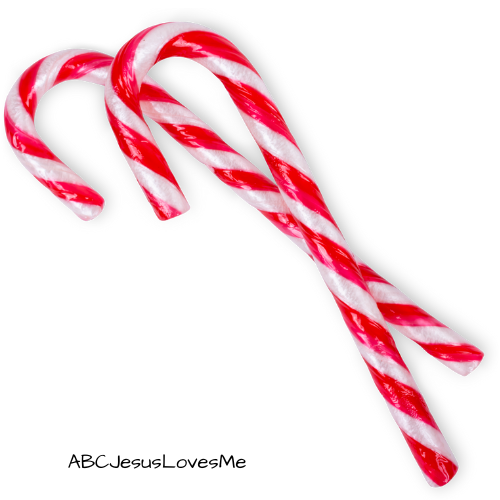
Place enough candy canes for each child to receive one inside a box. Wrap the box, then add several more layers of wrapping paper.
Ask the children Christmas story questions as they take turns unwrapping one layer of paper. Continue until the candy canes are revealed. Then give each child a candy cane.
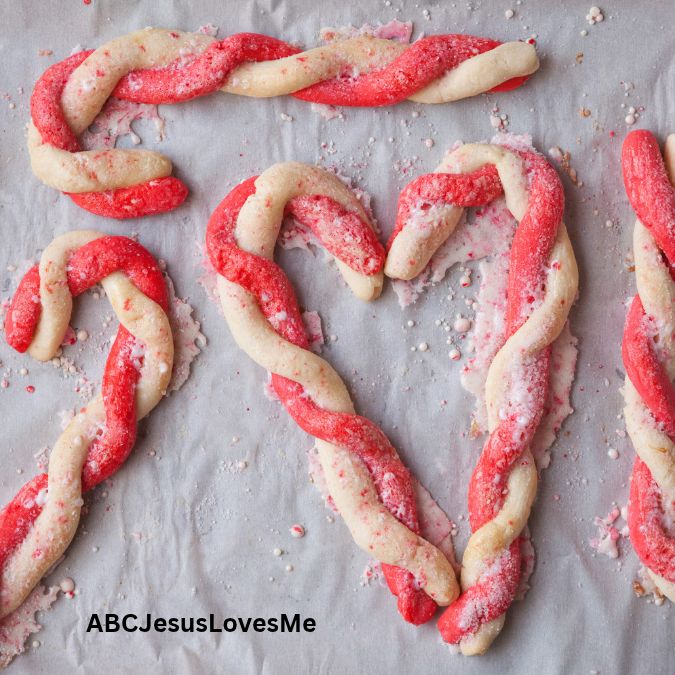
Prepare sugar cookie dough from scratch or use store-bought dough.
Divide the dough in half. Add red food coloring to one half and knead until the color is evenly distributed.
Cover both the red and white dough and refrigerate for at least 30 minutes.
Preheat the oven to 375°F.
On a lightly floured surface, roll about 1 tablespoon of red dough and 1 tablespoon of white dough into separate 8-inch ropes.
Twist the ropes together, pinching the ends to seal. Place the twist on an ungreased cookie sheet and gently bend the top to form a candy cane. Repeat with the remaining dough.
Bake for about 10 minutes, rotating the cookie sheet halfway through. Watch carefully to avoid overbaking.
Let the cookies cool on the sheet for 5 minutes, then transfer them to a wire rack to cool completely.